

Short answer: a wire wheel is the right choice when your build prioritizes classic styling, deep-lip drama and a lighter unsprung mass — but only after you confirm four things in writing: diameter and width, bolt pattern (PCD), offset (ET) with center bore, and the finish process. Most disappointments come not from the styling choice but from skipping the fitment check. This guide walks through each decision in the order a factory needs it, with typical spec ranges to use as a starting brief.
What Counts as a Wire Wheel
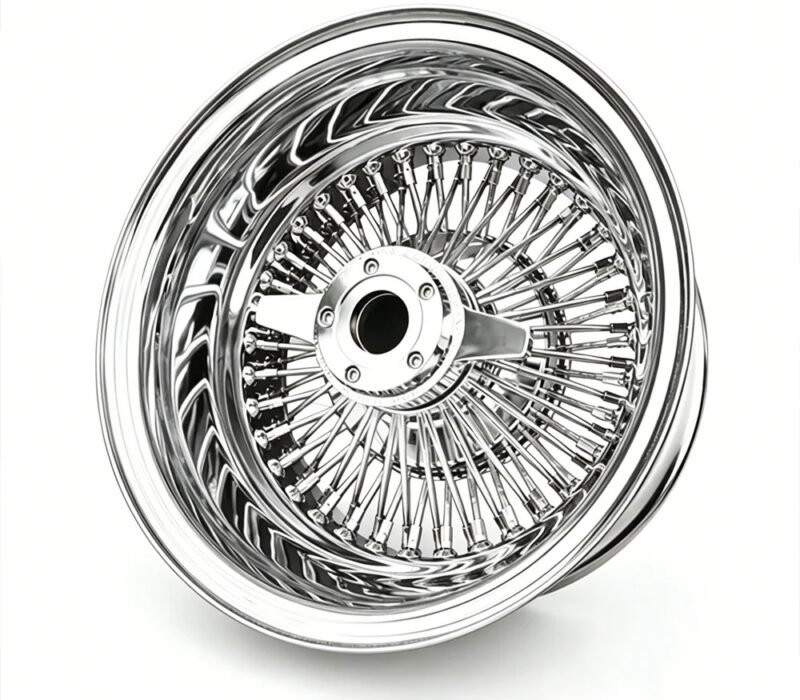
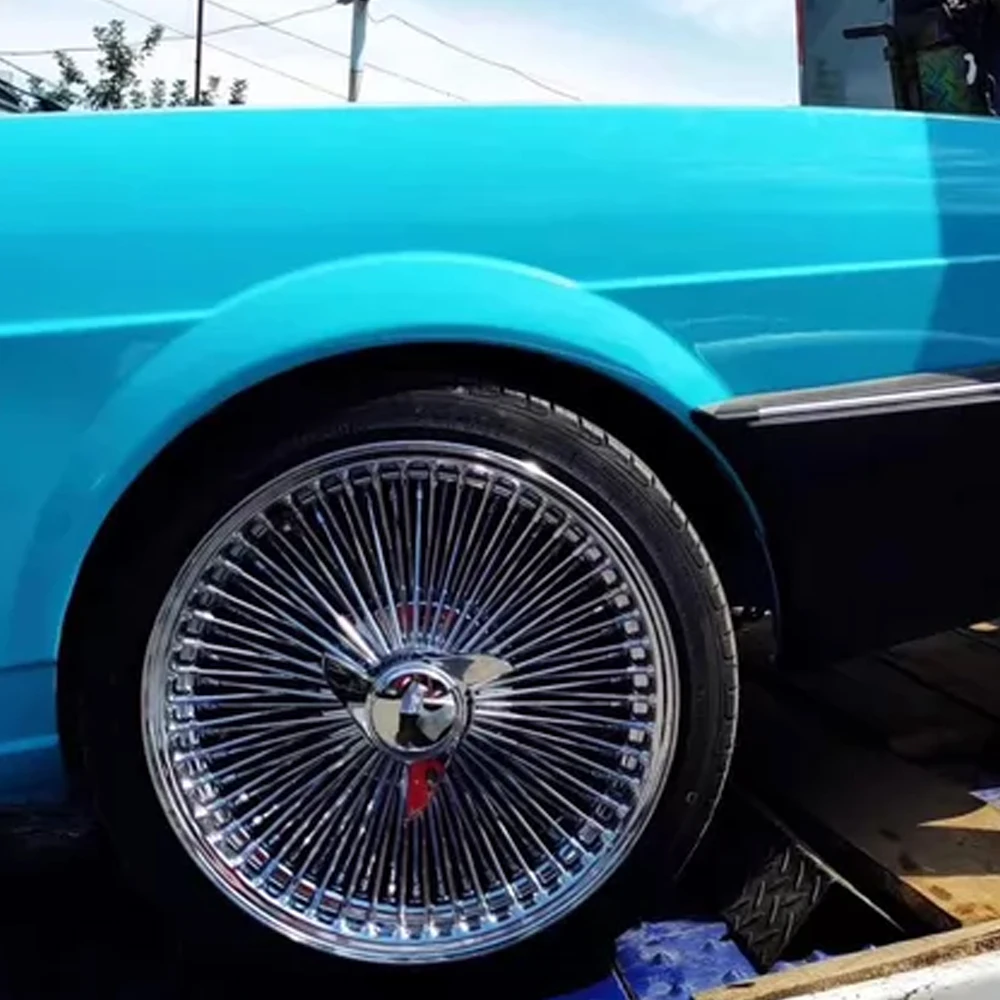
A wire wheel replaces the solid disc or cast face of a conventional rim with dozens of thin, individually tensioned spokes laced between hub and rim hoop. Common configurations run from around 50 spokes up to 150, in either cross-lace (spokes overlap in an X pattern) or straight-lace (spokes run parallel). Centers are usually machined aluminum; the outer hoop may be steel or aluminum alloy.
Two mounting systems exist:
- Lug-mount: bolts to the hub like any normal wheel, using your car’s existing studs.
- Knock-off (center-lock): a single locking spinner nut clamps the wheel to an adapter hub — and one side of the vehicle typically uses left-hand threads so torque does not loosen it. Many first-time buyers miss this.
Step 1: Diameter and Width
Diameter drives the whole look. Small diameters with tall sidewalls read “period-correct restoration”; large diameters with thin rubber read “modern show build.”
| Diameter | Typical width | Best suited for | Notes |
|---|---|---|---|
| 13 in | 7J | Compact classics, lowrider builds | Easiest to find whitewall tires with gold pinstripe |
| 14–15 in | 7J–8J | Full restorations | Widest tire selection, comfortable ride |
| 16–18 in | 8J–9J | Retro-mod daily drivers | More brake caliper clearance |
| 20–22 in | 8.5J–10J | Street custom, staggered setups | Confirm rear fender clearance before ordering |
| 24–26 in | 9J–11J | Show builds, full-size bodies | Expect speedometer recalibration and fender work |
A practical rule: keep the overall tire diameter within about 2–3% of the original fitment so the speedometer and gearing stay sane. For modern performance cars rather than classics, our forged wheel line covers monoblock and multi-piece designs that pair with the same sizing logic.
Step 2: Bolt Pattern, Offset and Center Bore
This is the step that decides whether the wheel actually bolts on. The bolt pattern (PCD) is written as stud count × circle diameter, for example 5×114.3. Measure it, do not guess it — several patterns look nearly identical to the eye.
| PCD | Commonly seen on | Typical hub bore |
|---|---|---|
| 4×100 | Compact and classic front-wheel-drive cars | 54.1–56.6 mm |
| 5×100 | Compact European and Japanese models | 56.1 mm |
| 5×114.3 | Very common across Japanese and American classics | 60.1–67.1 mm |
| 5×112 | Many German sedans and coupes | 57.1–66.6 mm |
| 5×120 | European sports sedans and larger coupes | 72.6 mm typical |
| 5×127 | Full-size American classics | 71.5 mm typical |
Offset (ET) is the distance from the wheel’s mounting face to its centerline, in millimeters. Lower ET pushes the wheel outward. Typical custom builds run ET 0 to +25; deep-dish or wide-body looks go lower but usually need fender rolling. The center bore matters just as much: if the wheel bore is larger than your hub, order hub-centric rings so the wheel centers precisely and does not vibrate at highway speed.
If this part of the spec sheet feels dense, our earlier walkthrough of PCD, offset and center bore explains how to measure each value with hand tools.
Step 3: Spoke Count and Lace Style
Spoke count changes both the look and the maintenance profile:
- 50–72 spokes: cleaner look, easier cleaning, common on restorations.
- 100 spokes: the classic full-lace show look, popular on 13–16 inch diameters.
- 144–150 spokes: maximum visual density, usually on larger diameters; longer wipe-down time after washing.
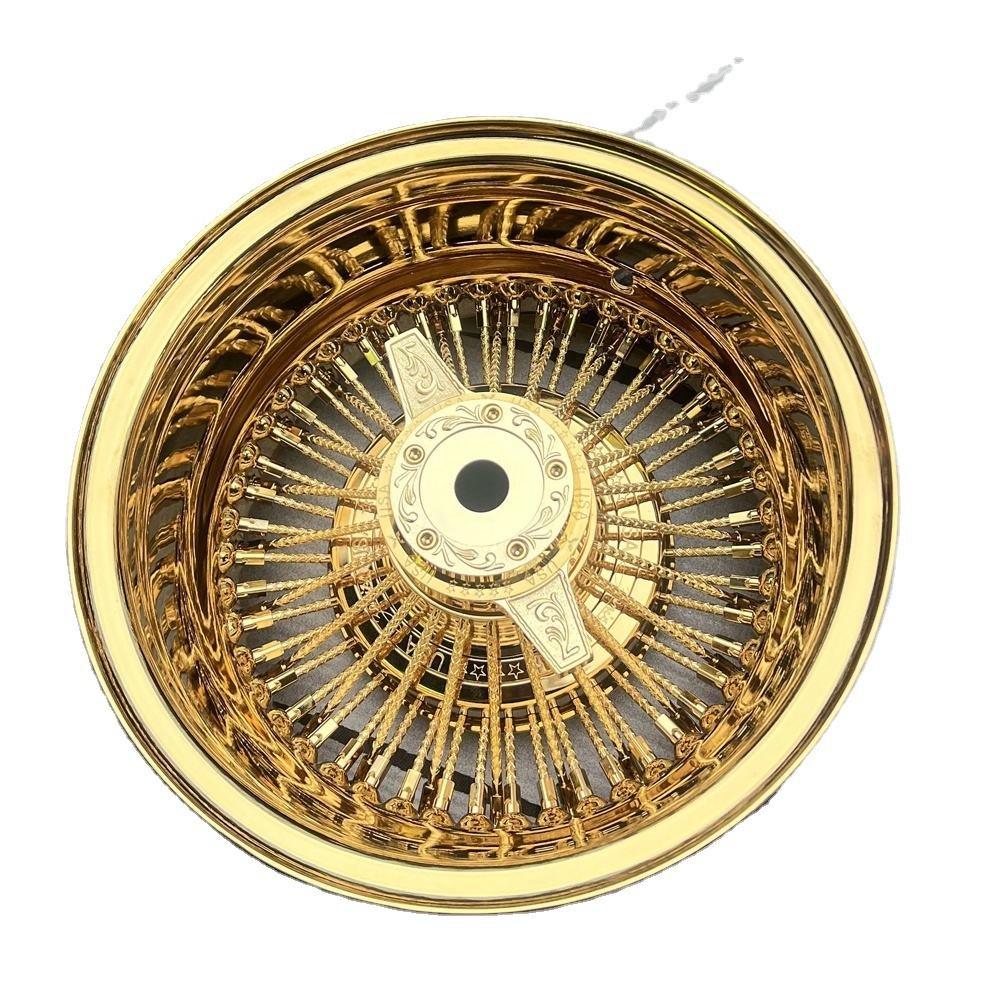
Cross-lace hides the valve stem and reads more traditional; straight-lace exposes the hardware and reads more industrial. For knock-off builds, decide early whether you want spinners — they add weight at the outer edge and require the left-hand-thread adapter hub.!100-spoke chrome wire rim in 13 to 16 inch sizes for classic custom projects
Step 4: Finish Options
Finishes on wire wheels are mostly plating-based, and the process differs by base material:
- Chrome plating: the most requested finish, typically a triple-layer stack (copper for leveling, nickel for corrosion resistance, chrome for the mirror surface). On steel hoops this stack is what protects the rim from rust, so plating thickness is a genuine quality question — ask what layers and thicknesses the supplier quotes.
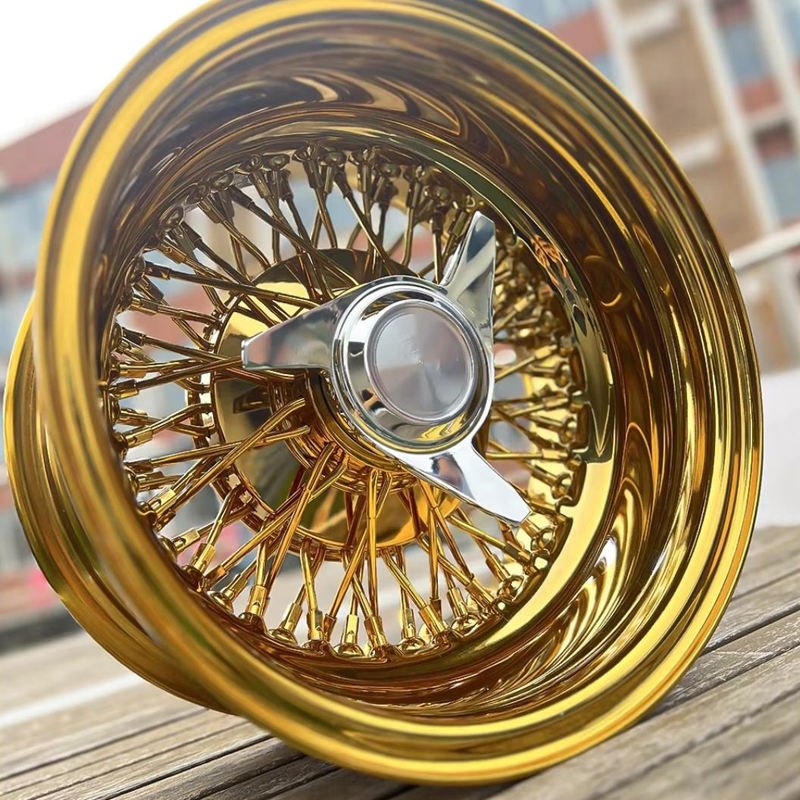
- Gold plating / gold-tone coating: electroplated gold-tone finishes and PVD-style coatings are both commonly quoted. Plated finishes read deeper in sunlight; coatings are generally easier to re-do locally if a wheel is damaged.
- Painted and powder-coated colors: practical for custom two-tone builds and easier to touch up than plating.
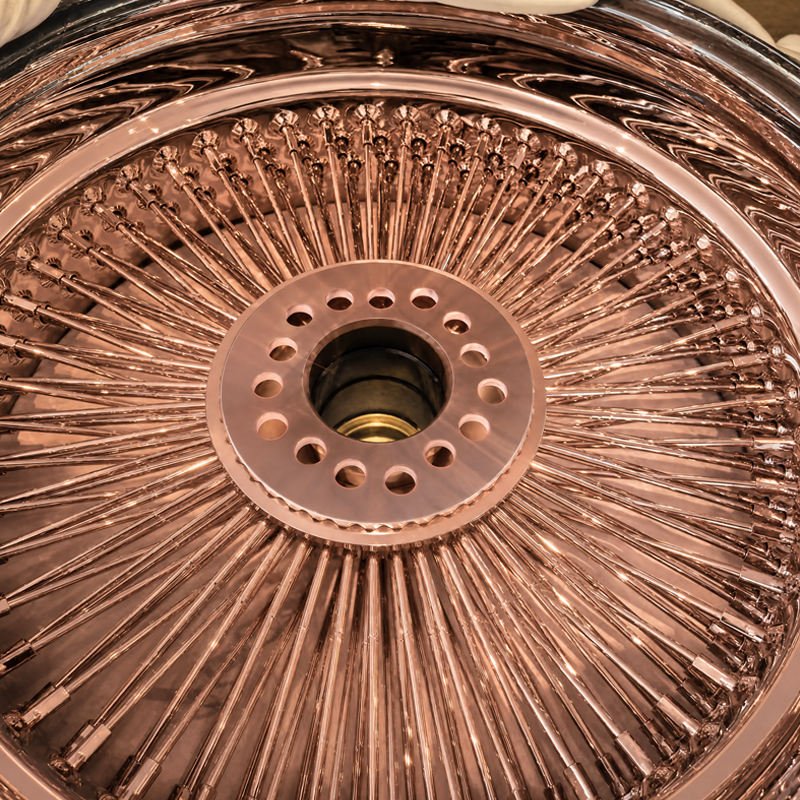
For classic luxury builds, rose-gold and two-tone (polished center with plated spokes) are frequent requests; our spoke wheel category shows the current range, including the rose-gold finish below.
Load Ratings, Materials and Quality Checks
Wire wheels carry a different load path than cast wheels: load transfers through individually tensioned spokes, so both spoke quality and assembly tension matter. Before ordering, ask the factory for:
- Material spec — typically forged A356 aluminum or heat-treated steel for the hub and hoop.
- Load test data — radial fatigue and 13° impact test results are commonly quoted on export wheels; ask for the actual report, not just a claim of compliance.
- Spoke tension procedure — wheels should be laced and trued on a jig, with tension checked after truing.
- Sealed vs tube-type rim — many wire wheels are not inherently airtight; if you plan to run tubeless tires, confirm the rim is sealed for it.
Do not expect a wire wheel to match the load rating of a modern cast SUV wheel at equal size — typical ratings are lower, one reason they suit lighter classic vehicles best.
Tire Pairing and Mounting Notes
Pair the tire to the era of the look: raised-whitewall tires with gold pinstripe for traditional builds, low-profile rubber for larger diameters. Our tire category lists the whitewall and performance sizes we stock for export orders. Mounting and balancing need an experienced shop:
- Ask the installer to protect the plated lip with rim protectors during mounting.
- Balance with a lug-centric or knock-off adapter, never a standard cone, or the assembly will vibrate.
- If the wheel is tube-type, have the shop check spoke-nut clearance inside the rim.
For buyers comparing materials, carbon construction sits at the other end of the weight spectrum — see our carbon fiber wheels overview for how the two categories differ.
Pre-Order Checklist
Before you send a wire wheel inquiry, have these six values ready:
- Diameter and width for each corner (staggered or square)
- PCD and center bore, measured from the hub
- Current ET and how far outward you want to sit
- Spoke count and lace style (cross or straight)
- Finish: chrome, gold-tone, painted or two-tone
- Tubeless or tube-type, plus your tire size plan
Send those six lines and a factory can quote accurately on the first pass.
Get a Custom Wire Wheel Quote from TH Wheels
TH Wheels manufactures wire spoke wheels in 13–26 inch diameters, multi-PCD drillings, cross-lace and straight-lace patterns, and full chrome, gold-tone and two-tone finish options, with export packing for wholesale and custom project orders.
- WhatsApp: +852 55709471 — chat now
- Email: info@tuhaoauto.com
- Contact page: tuhaoauto.com/contacts/
Send your vehicle year, current wheel size and target look, and we will come back with a fitment-checked quotation.